


Behavioral health experts explain when parents should consider therapy to treat a mental health challenge.
It’s normal for adolescents to experience emotional ups and downs. As teenagers begin to develop a sense of who they are and how they fit into the world many encounter stress. Some adolescents appear to handle the stress of middle and high school quite well, while others struggle and may need mental health support. Recognizing when a child or teen needs therapy can be difficult. How do parents know when a child should see a therapist? Are there signs?
We asked four Middle Tennessee therapists to share their thoughts about when parents should consider therapy for a child or teen. They all said that parents should seek the help of a mental health provider when their child’s symptoms become an impairment. But it also depends on whether the child and their parents are open to therapy and ready to put in the work required to develop healthy coping and communication skills.
“I believe adolescence is the best time for intervention,” said Lydia Thompson, LPC-MHSP, counselor and founder of Concord Family Counseling. “Adolescence is hard, no matter if your kid is quote unquote ‘normal’ or not. Seeking mental health help can impact them for the rest of their lives. So, I really think there is no bad time to seek therapy.”
Rebecca Stewart, LCSW, a therapist at Embrace U, said adolescent therapy works best when a child recognizes on their own that changes need to happen, “and demonstrates some significant level of motivation to follow through with those changes.” She added that for “ideal results” the entire family unit, especially caregivers, should be “willing and able to make changes.”
“I’d say the best time to bring a kid to therapy is when they ask for it,” Thompson said. “If they are asking for it, which more and more teens are asking to see a counselor, that’s the best time to get started.”
Signs a Child or Teen Needs Therapy
There are signs that indicate a child or teenager should receive mental health treatment. Topping this list are self-harm behaviors and suicidal ideation. Any child threatening to end their life should be taken to a mental health professional for assessment.
“If a child begins to seem sad often, pulling away from friends and family, feeling bad about themselves or having trouble engaging in school, these can all be signs that therapy may be helpful,” said Rachel Holloway, MS, LPC-MHSP, a therapist at Embrace U. “If a child can get the courage to begin talking about the heavy emotions they experience, it can open the door for growth and reflection.”
Parents should consider therapy if their child…
- talks about suicide or says things like, “I wish I wasn’t here.”
- expresses a sense of hopelessness.
- engages in self-harming behaviors like hair-pulling, bruising, or cutting.
- frequently engages in negative behaviors.
- worries excessively.
- has a significant change in sleeping or eating habits.
- experiences an academic decline.
- withdraws from friends and family.
- stops activities they used to enjoy.
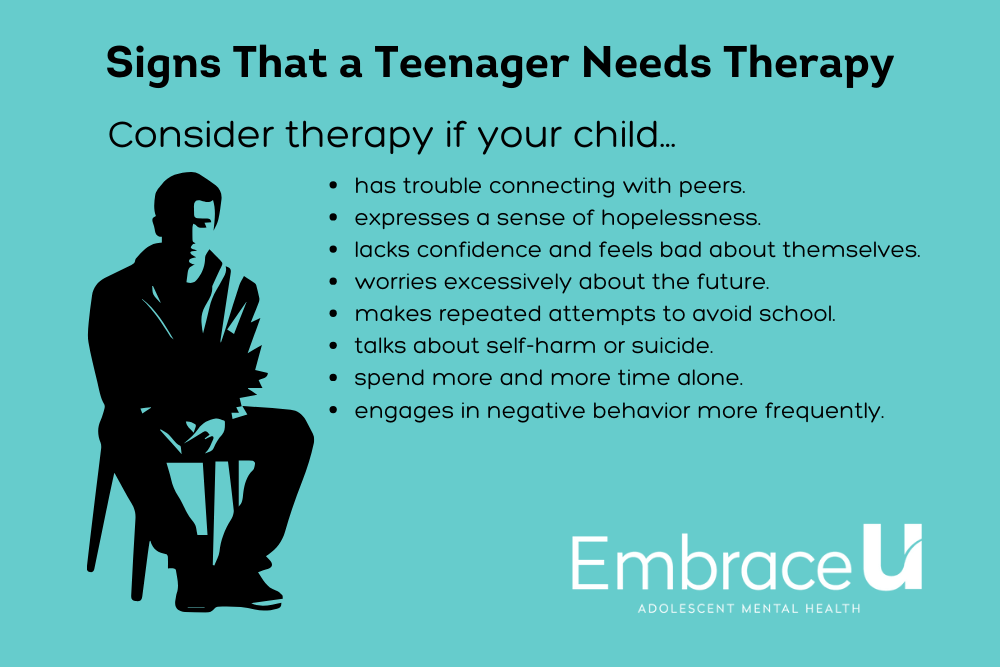
If your child experiences any signs of a mental health problem contact Embrace U to discuss treatment options.
Christine Finnegan, LPC-MHSP, NCC, MT-BC, founder and clinical director at Replenish Her Counseling, said impairment from symptoms of a mental health issue is a red flag.
“Is it impairing their ability to go to school? Is it impairing their ability to do their very best in the classroom? Is it impairing friendships? Are they not going out and wanting to be with friends? Are they not taking risks and trying new hobbies or sports, or doing things they once enjoyed? Those are impairments in my book, and that’s when therapy is needed,” Finnegan said.
Therapy should also be considered when a parent feels extremely disconnected from their child. Disconnection can be a sign that a child is trying to disconnect from the entire world, Thompson said.
“Other things to look for are lower grades, or severely different grades than they’ve ever had before,” said Thompson. “Are they dressing extremely differently? Have you noticed a huge change in their identity? I think that would be a good time to see a mental health counselor.”
How Therapy Can Help Teens
Whether your child is navigating typical developmental challenges or facing more serious issues, seeking help through therapy can improve their well-being and enhance family dynamics. By recognizing the signs of distress and reaching out for support, parents can equip their children with the tools they need to thrive emotionally as they mature and grow.
Adolescent therapy programs are designed to help participants build self-esteem and confidence, learn stress management techniques, develop coping mechanisms, and improve communication skills. Therapists are trained to address a wide range of issues, from family and school problems to mental health disorders like depression and anxiety. A therapist might meet with the child and parent together or meet with the child alone. They might also give parents tips and ideas for how to help their child at home. Therapists give praise and support as adolescents learn. Most participants in teen therapy programs experience a decrease in symptoms, improved academic performance, and more positive thought patterns after a few weeks of therapy.
Group therapy programs, such as those offered at Embrace U, can help teens learn from each other and become more assertive by sharing their experiences. Group therapy provides a safe, contained environment where adolescents participate in guided discussions and activities that help them feel heard and understood.
While many parents only consider therapy as treatment for a mental health crisis, meeting with a therapist can help teenagers develop mental fortitude and become better equipped for future challenges. Consider going to therapy like going to the gym. Both can create a stronger, healthier person.
“I see cases where you have a teen that is doing really well and going through all of their milestones, but their parents just want them to have a therapist,” Finnegan said. “That’s where we might just meet monthly. It’s more about giving a teen an adult outside of their family system that they can have a secure attachment with, that they feel safe enough to talk about the things that are hard in adolescence to talk about with your mom or dad.”